Day trips from Wieliczka within an hour's drive
Day trips from Wieliczka within an hour's drive. Niepołomice, Bochnia, Dobczyce, Tyniec and Ojców - travel times, what to see and how to pair it with the mine.
Most people come to Wieliczka with one aim in mind, which is to go down into the Salt Mine. The underground route takes several hours, and once you are back on the surface there is still half a day or a whole extra day of holiday left. That is when the question arises of which attractions near Wieliczka you can see without a long drive and without moving your luggage to another town. The answer is good news for drivers, because within an hour’s drive there are several places completely different from the mine. Each has its own character and takes a different amount of time to visit.
Wieliczka is conveniently located. The A4 motorway runs east from here to Bochnia and west towards Kraków, the road south leads to Dobczyce, and Niepołomice lies just beyond the northern boundary of the municipality. From a single base you can therefore plan two or three different trips and return to the same place each evening.
In this article we have gathered five destinations that we recommend for a car trip lasting anything from a few hours to a full day. They include a royal castle with a forest, a second UNESCO-listed salt mine, a castle above a lake, a monastery above the Vistula and the smallest national park in Poland. For each one we give an approximate travel time, how to visit it and a tip on what to combine it with. Our view is simple. Wieliczka works well as a base for a whole weekend, provided the order of trips is well planned.
Wieliczka as a base for exploring
Wieliczka lies where several regions of very different character meet. To the north stretches the Vistula valley with the Niepołomice Forest (Puszcza Niepołomicka), to the south begin the Wieliczka Foothills (Pogórze Wielickie), which rise into the Island Beskids (Beskid Wyspowy), and to the north-west of Kraków stands the Kraków-Częstochowa Upland with its limestone rocks. Within a few dozen kilometres, then, there is lowland forest, hills with a reservoir and Jurassic gorges.
This variety also has its roots in history. For centuries salt from Wieliczka and Bochnia filled the royal treasury, and rulers built defensive castles and residences in the area. According to material from the Bochnia Salt Mine, mining in Bochnia has been documented since 1248, and in 1368 King Casimir the Great issued the statute of the Kraków Saltworks, which regulated work in both mines. The same king began building the castle in Niepołomice, while the castle in Dobczyce guarded the crossing of the Raba river on the road from Kraków to Hungary.
For visitors this means that trips from Wieliczka fall into two groups. The first covers places linked to the same history of salt and the royal court, namely Niepołomice, Bochnia and Dobczyce. The second is nature and landscape, namely Ojców National Park and the cliffs above the Vistula at Tyniec. The two groups complement each other well. After several hours underground, many people prefer to spend the next day outdoors, in a forest or a valley, rather than in yet another museum.
In articles about Wieliczka the surrounding area usually appears as a list of names with no practical information. We focus on what matters to drivers. How long the drive takes, how much time to allow on site, whether the place is open seasonally and how to combine the trip with a visit to the mine so that you do not spend half the day in the car. Travel times are approximate, based on route planners, for driving outside peak hours. On a Saturday morning in high season they can be up to half as long again, especially on the Kraków ring road. Opening hours and ticket prices change every season, so for each place we refer you to the official website.
Niepołomice, a royal castle and a forest
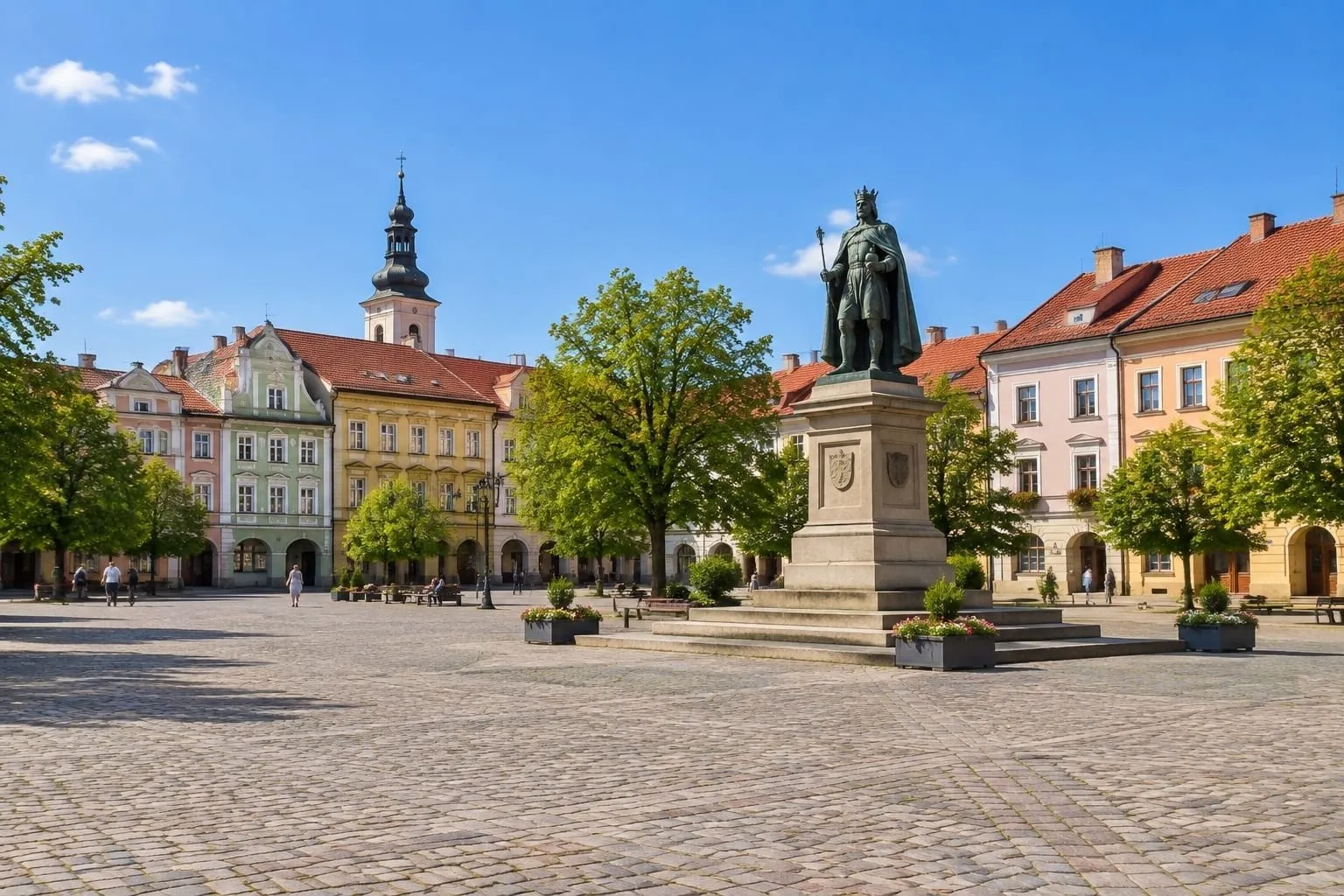
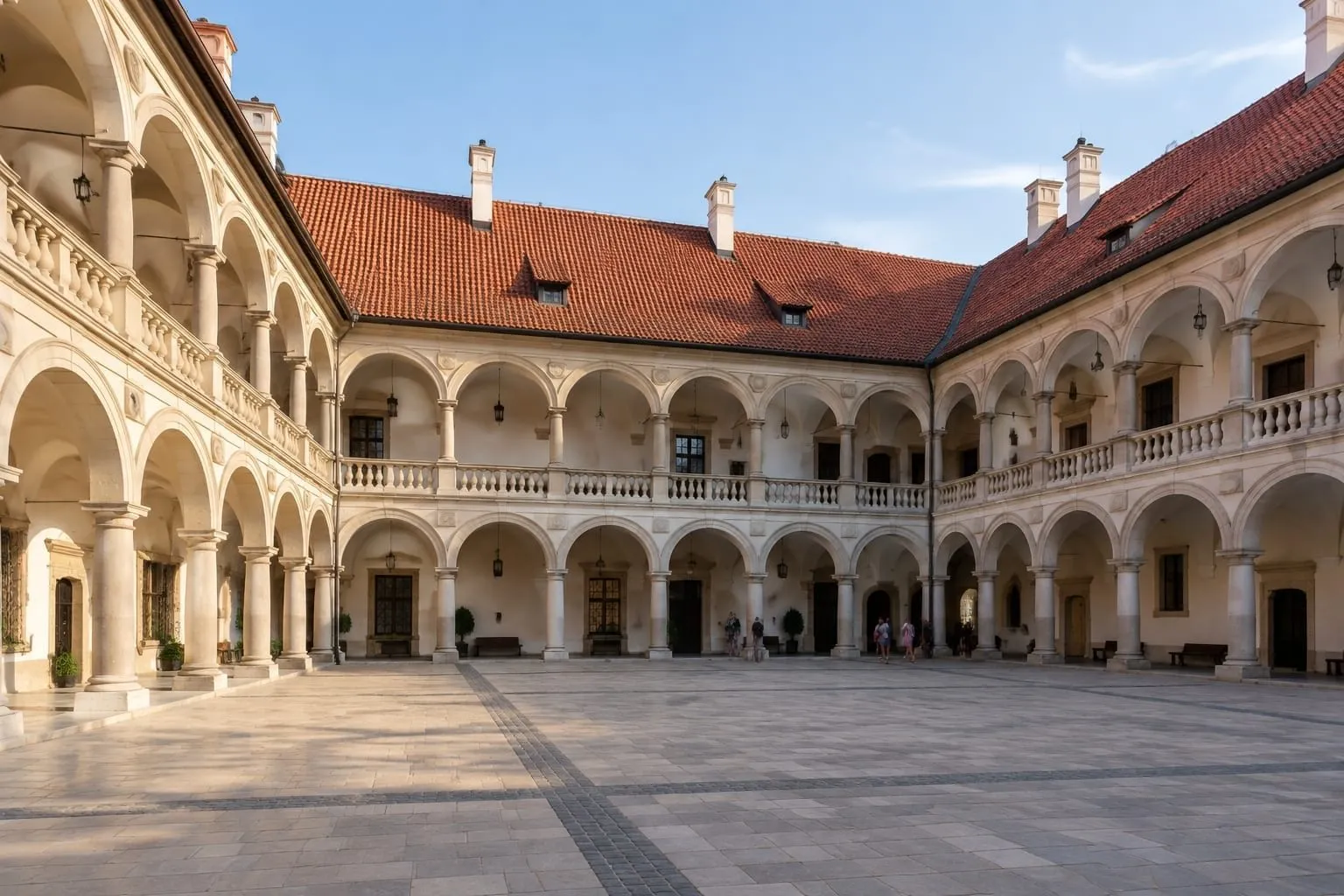
Niepołomice is the closest destination, a dozen or so kilometres from Wieliczka, which usually means about 20 minutes’ drive. The main sight is the Niepołomice Royal Castle (Zamek Królewski w Niepołomicach), built on the initiative of Casimir the Great and sometimes called a second Wawel. According to the Visit Małopolska website, its present appearance was given to it in 1551-1568 by Tomasz Grzymała and the Italian sculptor Santi Gucci, on the commission of King Sigismund Augustus. The castle has a four-sided layout with an arcaded courtyard.
The building’s fortunes reflect the history of the region well. During the Swedish Deluge it served as a storehouse, after the First Partition the Austrians turned it into barracks, and after the Second World War it fell into ruin. Restoration began in 1991, when the municipality took over the castle. Today it houses the Niepołomice Museum, a hotel and a restaurant.
The Niepołomice Forest
Royal hunts set off from the castle into the Niepołomice Forest, which begins just outside the town. It is a good place for a walk or a bike ride along flat forest tracks. At the heart of the forest is the Niepołomice Bison Breeding Centre, founded in the 1930s. The centre itself is closed to visitors, but in 2023 a viewing platform was built by the fence, outside its grounds, from which the animals can sometimes be seen.
In the town itself it is worth crossing the market square to the Church of the Ten Thousand Martyrs, founded by Casimir the Great in 1350, which stands a few minutes from the castle. Opening hours of the museum and temporary exhibitions are best checked on the Niepołomice Museum website, as the programme changes during the year.
Half a day is enough for Niepołomice. It fits well into an afternoon after a morning visit to the mine, because the drive is short and the castle and the park beside it do not involve a long walk.
Bochnia, a second UNESCO-listed salt mine
Bochnia lies east of Wieliczka, about 25-30 minutes’ drive along the A4 motorway. Since 2013 the Bochnia Salt Mine has been on the UNESCO World Heritage List as an extension of Wieliczka’s 1978 listing. UNESCO describes the two sites as the oldest of their kind in Europe.
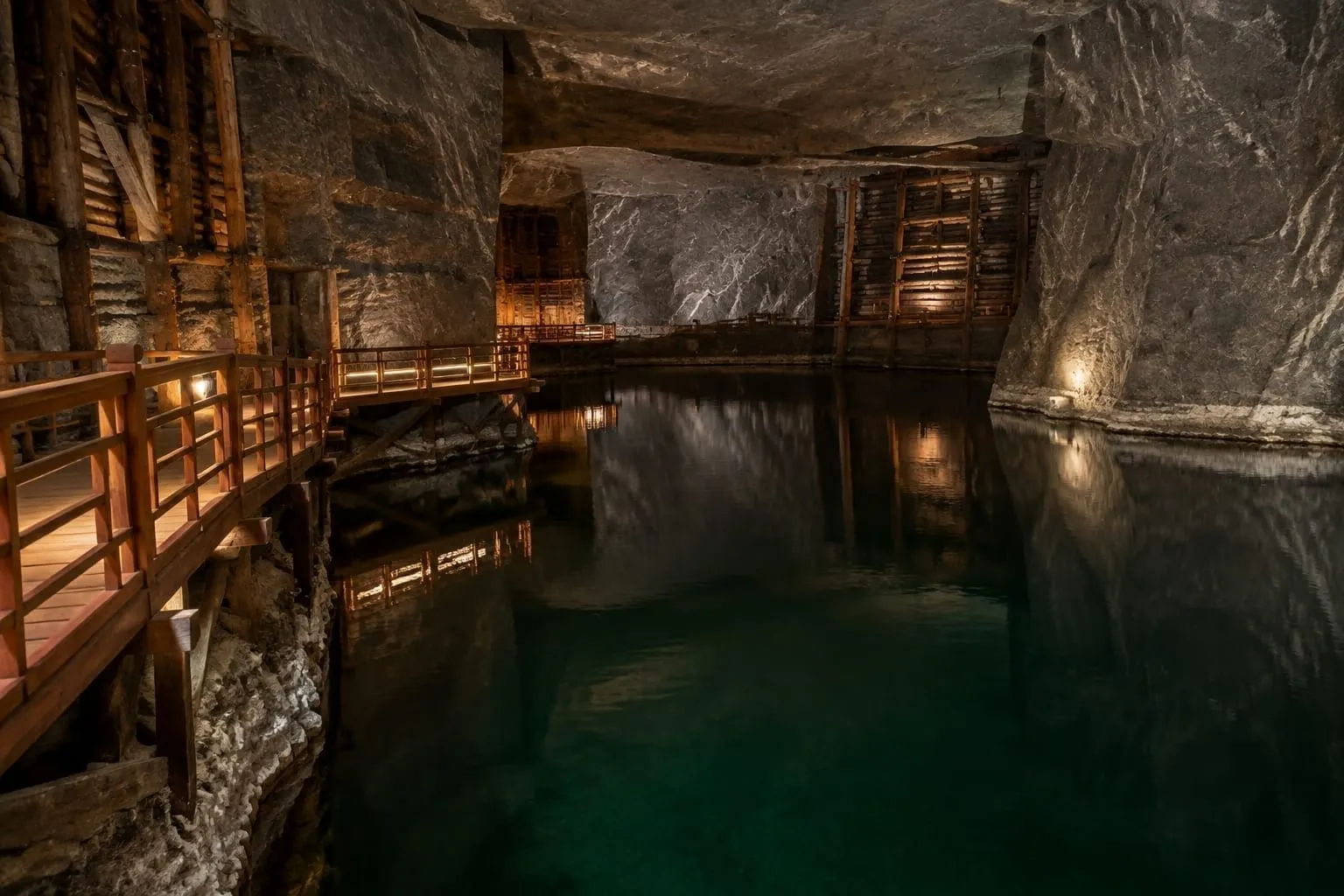
A visit to Bochnia is different from one in Wieliczka. According to the mine’s official website, the basic route with the Underground Multimedia Exhibition involves about 3 km of walking with many steps, and the visit takes 3 to 4 hours. Part of the route is covered by an underground mining train, and selected options include a boat crossing through a flooded chamber. In the Ważyn Chamber there is a 140-metre slide (for ages 9 and over) as well as a sports pitch and a playground for children. The mine also organises overnight stays underground.
Tickets bought online are cheaper than at the ticket office and can be purchased up to 60 minutes before the route starts. On summer holiday weekends places for popular times sell out quickly, so buying a few days in advance saves a lot of stress. It is cool in the mine all year round, so a sweatshirt or light jacket will come in handy, just as in Wieliczka.
One salt mine or two
Two mines in one day is too much for most families, because each involves several hours of walking. It is better to spread them over two days. We have described a detailed comparison of both routes in our article Bochnia or Wieliczka Salt Mine.
Dobczyce, a castle above a lake
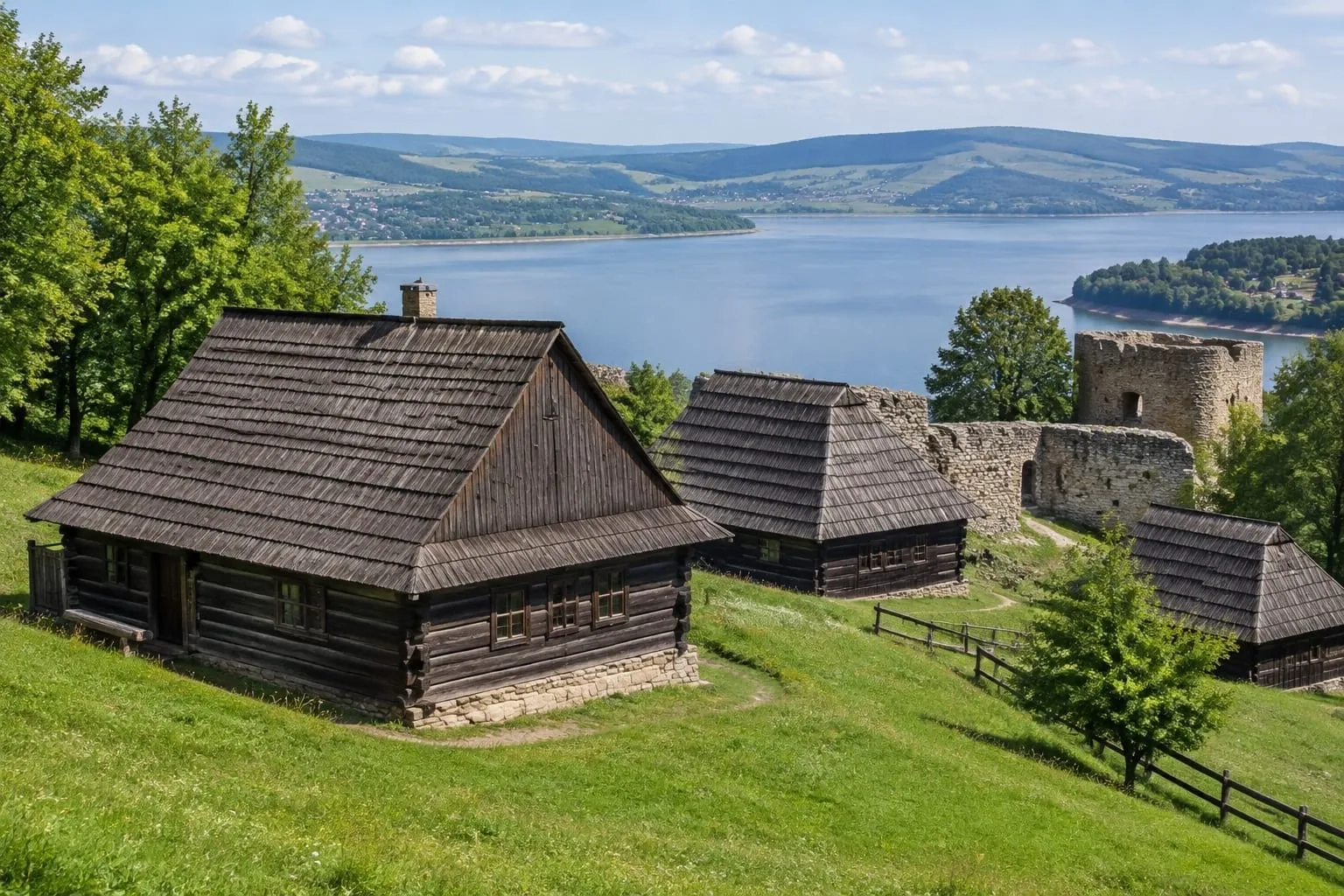
Dobczyce lies south of Wieliczka, about 30 minutes’ drive away. On a hill above the Raba river stand the ruins of a royal castle, partly rebuilt in the second half of the 20th century by local history enthusiasts. According to the Dobczyce municipality website, the castle is first mentioned in 1362, and in the time of King Casimir IV Jagiellon the king’s sons were taught here by Jan Długosz. In 1593-1594 the Lubomirski family converted the Gothic fortress into a Renaissance residence.
On the hill you will find the Władysław Kowalski PTTK Regional Museum, and next to the castle an open-air museum with a 19th-century inn, peasant and townspeople’s houses and a forge. From the walls you can see Lake Dobczyce (Jezioro Dobczyckie), a reservoir that, according to Polish Waters (Wody Polskie), was put into service in 1986. It is one of the main sources of drinking water for Kraków, which is why swimming and boating on the reservoir itself are restricted.
The dam rests against the castle hill, and from its crest in season there is a view over the lake and the surrounding hills. Dobczyce takes 2-3 hours and suits a relaxed trip with children or older relatives, without much walking. According to the municipality, the museum and the open-air museum are open from Tuesday to Sunday, but opening days and hours outside the season are best confirmed by phone with the local PTTK branch. From the castle hill you can walk down to the bank of the Raba below the dam, where there are footpaths and a cycle route around part of the lake.
Tyniec, an abbey on a cliff above the Vistula
Tyniec Abbey (Opactwo Benedyktynów w Tyńcu) lies within the city limits of Kraków, on its south-western edge. The drive from Wieliczka takes about 35-40 minutes, going round the city on the ring road. According to historical sources, the monastery was probably founded around 1044, during the reign of Casimir the Restorer, and Benedictine monks still live there today. The abbey has been designated a Monument of History.
The buildings stand on a limestone hill above the Vistula, and the courtyard is accessible without a ticket. The abbey museum presents the history of the monastery in historic interiors. Below the hill runs the Vistula Cycle Route (Wiślana Trasa Rowerowa), popular with cyclists. From the courtyard and the walls there is a view of the bend in the Vistula and the meadows outside Kraków, especially lovely at sunset. The abbey has a shop selling Benedictine products and a café, which makes a short stop easy without having to look for somewhere to eat nearby.
Two hours is enough for Tyniec, and the visit is easy to combine with an afternoon in Kraków. Arriving in the morning, before organised groups turn up, is also a good idea. The Benedictines still lead a monastic life here, so quiet and appropriate dress are expected in the church, especially during services.
Ojców and Pieskowa Skała, gorges and caves
Ojców National Park (Ojcowski Park Narodowy) is the furthest destination on our list. The drive from Wieliczka takes about 50-60 minutes, via the Kraków ring road and the road towards Olkusz. The park was established in 1956 and, according to Radio Kraków, is the smallest national park in Poland, covering about 2,146 ha. Despite its small size, it has a very varied landscape, with the Prądnik gorge, limestone outcrops and caves.
The best-known sights are the Kraków Gate (Brama Krakowska), King Łokietek’s Cave (Jaskinia Łokietka), the ruins of the castle in Ojców and Hercules’ Club (Maczuga Herkulesa), a club-shaped limestone rock below Pieskowa Skała Castle. The castle itself, a branch of the Wawel Royal Castle since 1958, now hosts the exhibition “Old Polish Culture” (Kultura staropolska) following a recent modernisation. The caves are visited seasonally with a guide, and inside the temperature is about 9 degrees all year round.
The park is best explored on foot. The main road runs along the floor of the Prądnik Valley, and from it marked trails lead to the Kraków Gate and King Łokietek’s Cave, often along steep, rocky paths. Comfortable shoes with good soles matter more here than in the mine. It is worth setting aside a whole day for Ojców and Pieskowa Skała, and checking the park’s website before leaving to see whether any trails are temporarily closed, which happens in winter when they are icy.
| Destination | Drive from Wieliczka (approx.) | Time on site | Best for |
|---|---|---|---|
| Niepołomice | approx. 20 min | 2-4 hrs | history, forest walks |
| Bochnia | approx. 25-30 min | 3-4 hrs | families with children, a second salt mine |
| Dobczyce | approx. 30 min | 2-3 hrs | a relaxed trip, views |
| Tyniec | approx. 35-40 min | approx. 2 hrs | history, cycling, combining with Kraków |
| Ojców and Pieskowa Skała | approx. 50-60 min | full day | hiking, nature |
How to plan day trips from Wieliczka
The easiest way to plan day trips from Wieliczka is to follow the rule of one major sight per day. If we go down into the mine in the morning, in the afternoon we choose something close and short, such as Niepołomice or Dobczyce. We leave Ojców and Bochnia for a separate day, because each of them takes several hours.
A sample weekend might look like this:
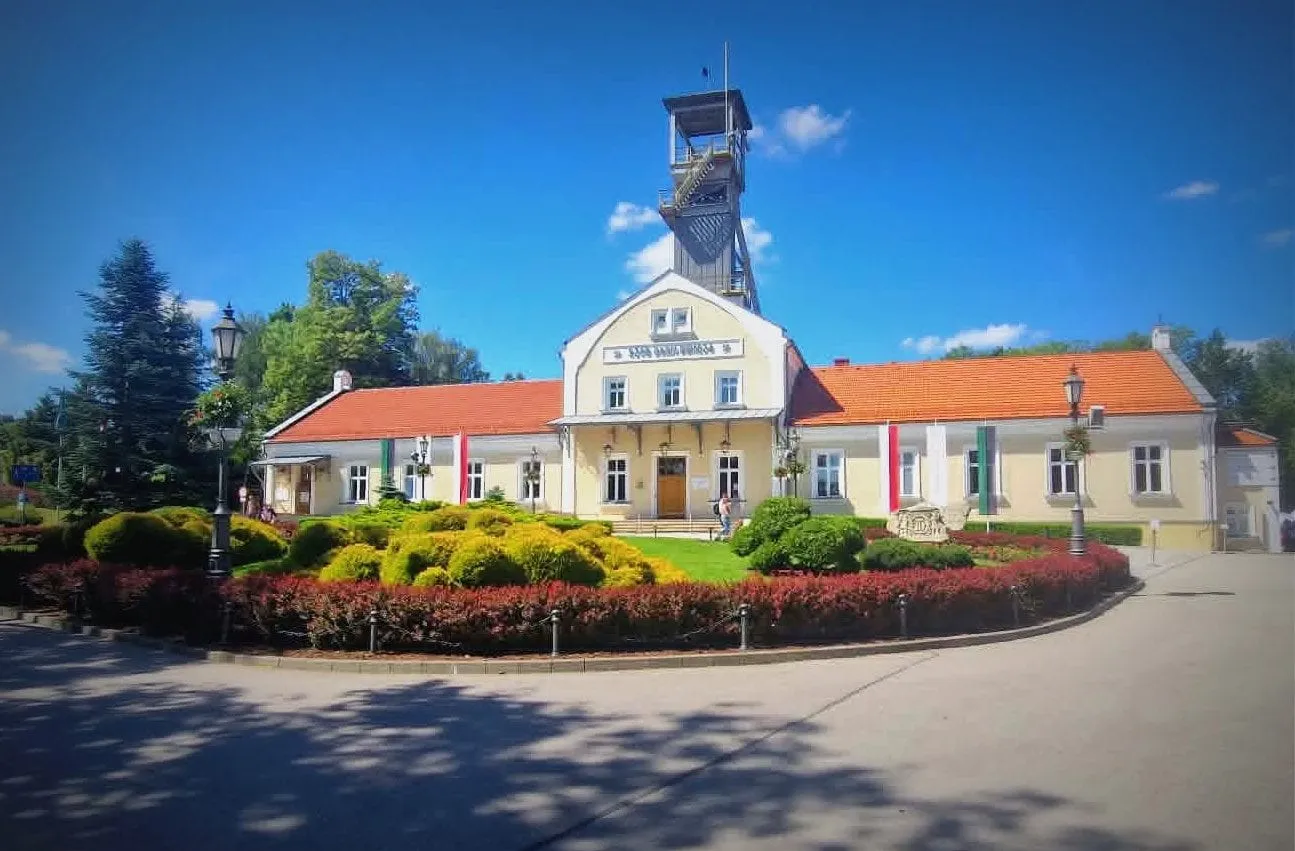
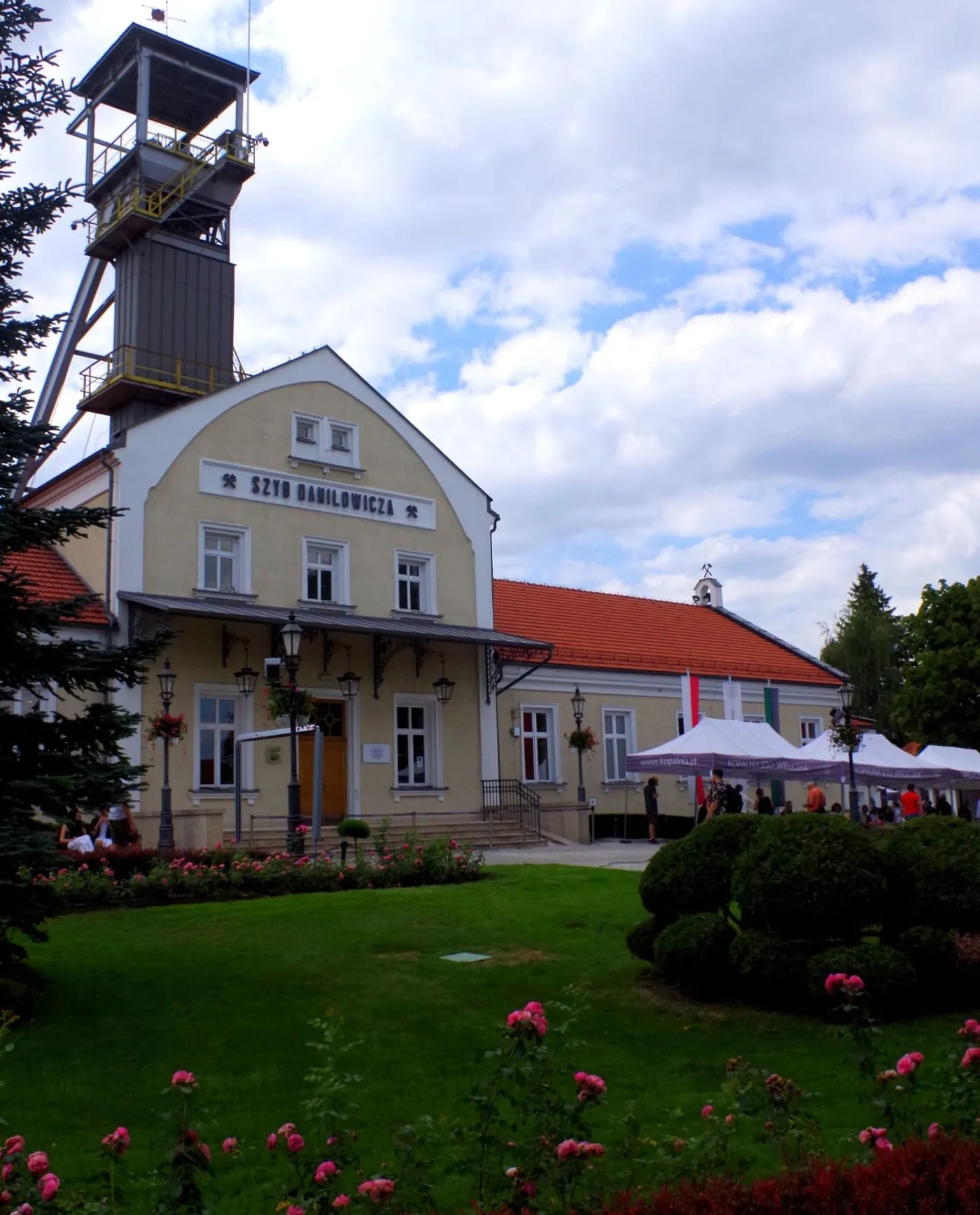
- Saturday morning - the Wieliczka Salt Mine, then lunch by the Daniłowicz Shaft and a walk to the Saltworks Castle.
- Saturday afternoon - Niepołomice, the castle and a short walk in the forest.
- Sunday - Ojców National Park with Pieskowa Skała, or Bochnia if there are children in the group who want the slide and the boat.
A day at the mine is easiest to start with a parking space already secured. We recommend the salt mine car park with online booking, located about 30 m from the Daniłowicz Shaft (Szyb Daniłowicza). The ticket with a QR code arrives by email, entry is possible from 7:00 to 18:00 and exit around the clock, which makes it easier to return from an evening trip in the area. From the car park it is a few minutes’ walk to the Saltworks Castle (Zamek Żupny), which we cover in more detail in our article on the Saltworks Castle in Wieliczka.
A few practical tips for trips into the surrounding area:
- during “majówka” (the early May holiday period in Poland) and the summer holidays there are queues on the A4 and the Kraków ring road, so it is better to set off for Ojców and Tyniec before 9:00,
- the caves, the open-air museum and the dam crest are open seasonally, so it is worth checking the hours the day before,
- it is cool in caves and mines, so keep a jacket in the car for the whole day,
- in Ojców the car parks along the main road fill up quickly on sunny weekends,
- on a trip with children it is worth bringing food, as there are few places to eat in the Niepołomice Forest and the Prądnik Valley,
- when leaving the mine in the afternoon for Niepołomice or Dobczyce, allow extra time for sightseeing, as some places close their ticket offices earlier than the exhibitions themselves.
New investment in the area
For several years the area around Wieliczka has been investing steadily in tourism. At Pieskowa Skała a major modernisation project has been completed, covering the courtyard, the chapel and a new permanent exhibition, and the site has been adapted to the needs of visitors with disabilities. In Dobczyce the municipality is running a project to renovate the open-air museum and the museum on the castle hill.
The Bochnia mine is expanding its offer with themed routes such as “Salt Witness” (Solny Świadek) and versions accessible to visitors with disabilities. In Tyniec there are plans to open the medieval cellars as a museum of Benedictine history. Each of these changes increases the time worth setting aside for the place in question. Since 2023 an observation platform has stood by the fence of the bison centre in the Niepołomice Forest, making it easier to watch the animals without entering the breeding grounds.
For visitors planning a trip in 2026 and 2027 this means one thing. A trip around the area is no longer an add-on for a spare hour but a fully fledged part of the holiday. More and more people stay in Wieliczka for two or three nights and use it as a base for the whole area. It is also worth following announcements from the sites, as renovation work can temporarily close parts of routes or exhibitions. Cycle routes are growing in popularity too, such as the Vistula Cycle Route at Tyniec and the trails in the Niepołomice Forest, so more and more people bring bikes on a car rack.
Day trips from Wieliczka at a glance
Attractions near Wieliczka fall into two groups. The first is the heritage of salt and the royal court, namely the castle in Niepołomice, the Bochnia Salt Mine and the castle in Dobczyce. The second is nature and landscape, namely Ojców National Park with Pieskowa Skała and the abbey at Tyniec on a hill above the Vistula. All of these places are within an hour’s drive.
The closest are Niepołomice and Dobczyce, which fit well into an afternoon after visiting the mine. Bochnia and Ojców need a separate day. Tyniec is easy to combine with a visit to Kraków, ideally in the morning or late afternoon. When planning, bear in mind the seasonal opening hours of the caves and the open-air museum, as well as queues on the A4 on long weekends. A sensible plan is one major sight per day, with spare time for lunch, a rest and an unhurried return before dark.
Coming back to the view set out at the start, Wieliczka works well as a base, and a car gives you a great deal of freedom here. The day begins by the Daniłowicz Shaft, and the following days can be devoted to castles, the forest and the Jurassic rocks. After returning from a trip there is time for dinner in central Wieliczka and an evening stroll by the graduation tower (tężnia). Before you arrive, we recommend that you book a parking space in Wieliczka for the day of your mine visit and check the opening hours of your chosen places on their official websites.
Questions about day trips from Wieliczka
What is there to see near Wieliczka with children?
The best option is the Bochnia Salt Mine, with an underground train, a boat crossing, a slide for children aged 9 and over and a playground. Dobczyce is also a good choice, with an open-air museum where children can look inside an old inn and a forge, as is the viewing platform by the bison enclosure in the Niepołomice Forest.
Can you visit Wieliczka and Ojców in one day?
You can, but it will be a very full day. The mine takes several hours, and the drive to Ojców takes about an hour each way. We recommend spreading these places over two days. On the first day the mine and a walk around central Wieliczka, on the second an early start for Ojców, while the Kraków ring road and the Prądnik Valley are still quiet and the car parks by the trails still have free spaces.
Which attraction is closest to Wieliczka?
Niepołomice is the closest, about 20 minutes’ drive away. The Royal Castle and the Niepołomice Forest are enough for half a day. The route follows local roads without joining the motorway, so it is a good choice on days when there are queues on the A4 as well.
Are there attractions near Wieliczka that are open in winter?
Yes. The salt mines in Wieliczka and Bochnia are open all year, as are the castles in Niepołomice and Pieskowa Skała. The caves in Ojców and some of the attractions in Dobczyce are mainly seasonal. In winter the trails in Ojców National Park can be icy and are sometimes closed temporarily, so it is worth checking the park’s announcements before setting off.
Where can you leave the car while visiting Wieliczka before a trip into the surrounding area?
It is convenient to park by the Daniłowicz Shaft, where the Tourist Route begins. The car park 30 m from the Daniłowicz Shaft takes online bookings for a specific day, and you can drive out at any time.
Is Tyniec worth a visit if you have already been to Kraków?
Yes, because the abbey lies outside the centre and shows a different side of the city. The monastery on a hill above the Vistula, the museum and the cycle route along the river make a calm change after the crowded Old Town.
How much time should you set aside for the area around Wieliczka?
One day is enough for the Wieliczka mine and one nearby attraction, such as Niepołomice. If your plan also includes Bochnia or Ojców, you will need two or three days. When travelling with children, it is better to plan shorter days with a longer lunch break.