Wieliczka Saltworks Castle - History and Visiting in 2026
The Wieliczka Saltworks Castle is under renovation until the end of 2028. We explain its history as the salt works seat and what to see in Wieliczka meanwhile.
Anyone planning a visit to the salt mine will sooner or later come across the name Wieliczka Saltworks Castle (Zamek Żupny). The complex stands a few minutes’ walk from the Daniłowicz Shaft and has medieval walls, a Gothic hall and a collection of salt cellars counted among the most valuable in the world. For more than six centuries it served as the office, treasury and canteen of the largest enterprise in old Poland, the Kraków Saltworks (Żupy Krakowskie). Without this institution it is hard to understand why a small town near Kraków was so important to the royal treasury for centuries.
In 2026, however, the situation is different from what guidebooks from a few years ago describe. According to the Kraków Saltworks Museum in Wieliczka (Muzeum Żup Krakowskich Wieliczka), the castle and its courtyard are closed for renovation work, which will last until the end of 2028. Many people only find this out at the gate on ul. Zamkowa, even though a day in Wieliczka is usually planned around several places just a few minutes apart.
That is why this article has two aims. The first is to give a reliable account of the castle’s history, its buildings and its collections, based on the museum’s own materials. The second is a practical answer to the question of what part of this history can be seen now, before the castle reopens in a new form. Our view is simple and follows from the facts given by the museum. The renovation does not make getting to know the Saltworks Castle pointless, because the most important part of the story of Wieliczka salt can be seen underground in 2026, on the Museum Route in the mine, and the rest from the outside and on a virtual tour.
The Saltworks Castle and the Kraków Saltworks Museum
The word “żupa” once meant a salt mine, and “Żupy Krakowskie” (the Kraków Saltworks) was the name of the enterprise that included the mines in Wieliczka and Bochnia as well as the brine boiling houses. The museum states that in the 14th century salt from this enterprise provided as much as a third of royal revenue. From the end of the 13th century the Saltworks Castle was its headquarters, the place where decisions were made, accounts were kept and deals were struck.
The castle’s role was more administrative than defensive, although the walls mattered too. In the morning, miners were called to work from the castle tower with bagpipes, and later with a trumpet. Tools and tallow for lighting the workings were issued from the storerooms. Wages were paid here, and meals were served in the saltworks kitchen. The museum calls it the first staff canteen in Poland. Merchants paid at the castle for salt, which they later collected at the shafts. The castle also housed a court, a prison and a chapel.
The salt works officials produced financial and technical records, including a unique set of maps of both mines. In the Austrian period the castle began to serve tourists for the first time, as this is where admission tickets to the mine were sold. The complex remained the seat of the salt administration until 1945, when aerial bombs destroyed its central section.
Today the castle is home to the Kraków Saltworks Museum in Wieliczka, which has two exhibition spaces, the castle above ground and a route on Level III of the mine. The Wieliczka mine was inscribed on the UNESCO World Heritage List in 1978, and in 2013 the World Heritage Committee extended the listing to include the Bochnia mine and the Saltworks Castle. The site is therefore protected as part of a single ensemble, the “Royal Salt Mines in Wieliczka and Bochnia”. This matters for understanding the whole, because UNESCO recognises the mine and the castle as two sides of the same heritage. Salt was extracted underground, while its sale, the workforce and the money were managed above ground.
The gap this article fills is a practical one. Most descriptions of the castle online were written before the renovation and give opening hours and prices that no longer apply. Below we have gathered current information and show how to explore this history in 2026-2028.
The Wieliczka Saltworks Castle in 2026
The most important information for visitors is this. On its opening hours and prices page, the museum states that the Saltworks Castle and its courtyard are currently closed, and the work will last until the end of 2028. In an announcement about the project co-funded by the FEnIKS programme, the planned date for opening the castle in its new form was given as the turn of 2028 and 2029. So there is no point planning to visit the interiors or the courtyard in 2026.
The scale of the work is considerable. Most of the costs are covered by European Funds. In December 2025 the museum signed a contract with the contractor for the next stage of the reconstruction. The work covers the Middle Castle and the South Castle, the installation of lifts, the rebuilding of staircases and an underground link between the North and Middle Castles.
A discovery during construction
The renovation has also brought a find. During earthworks in the South Castle, a stone wall was uncovered which, according to experts, probably dates from the 14th century and formed part of the old fortifications. The discovery was reported by the museum and National Geographic Polska. By decision of the heritage conservator, the remains will be protected and may be shown to visitors in the future.
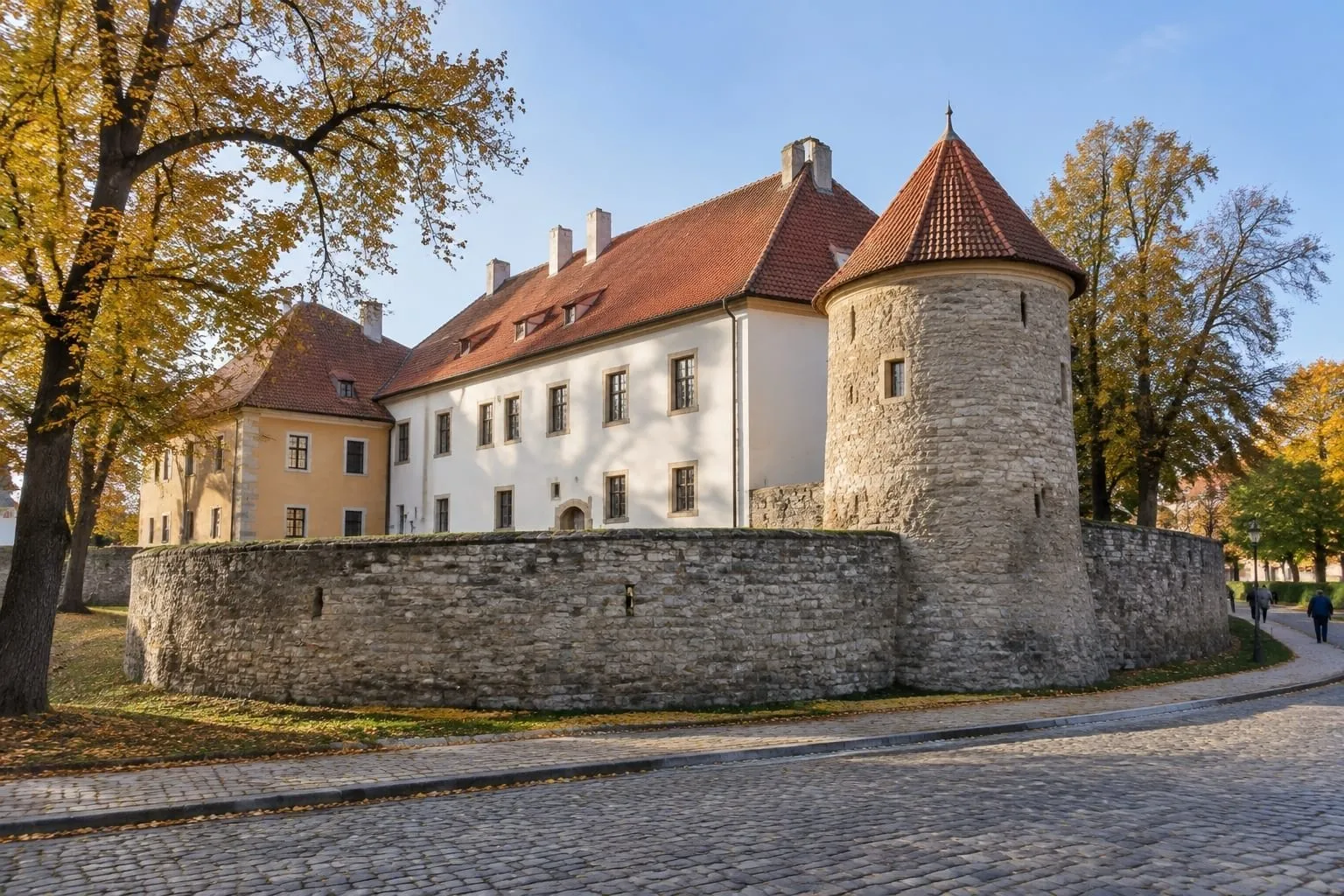
For visitors this means that in 2026 the castle can be viewed from the outside, from ul. Zamkowa, bearing in mind that part of the site is a building site. It is worth checking the current situation on the museum’s website before you arrive.
Seven centuries as the seat of the Kraków Saltworks
The oldest part of the complex is a building from the end of the 13th century known as the “House Amid the Saltworks” (Dom Pośród Żupy), today the Middle Castle. The museum describes the original castle as a tower measuring 16 by 10 metres, surrounded by an oval wall of Beskid sandstone. This layout protected people, tools, documents and, of course, the salt.
Casimir the Great and the Renaissance
In the time of Casimir the Great the castle was considerably enlarged and rebuilt in brick and stone. The king introduced the custom of annual visits to the castle, and monarchs came here regularly throughout the Middle Ages. Casimir the Great also surrounded the town with a wall with two gates and 19 towers. The only surviving tower of the medieval town fortifications stands right by the castle.
In the 15th century the Saltworks House (Dom Żupny) was built, today the North Castle, with a chapel, a library and apartments for senior officials. During the Renaissance, with the help of Italian architects, the castle was transformed into a Renaissance residence. On the ground floor of the main building was the Court Chamber (Izba Grodzka) with a rib vault resting on a single pillar, and one floor up the Royal Hall with coats of arms and a gallery of Polish rulers.
From the queen’s apartment to the salt works management
The museum recalls that in 1683 an apartment was prepared in the castle for Queen Maria Kazimiera Sobieska so that she could stay the night here while her husband was returning from Vienna. Sources from the early 16th century, in turn, mention a clockmaker and a mechanical tower clock above the House Amid the Saltworks.
The period of the partitions erased traces of former splendour, but the castle remained an important administrative centre. The chief manager of the salt works lived here. A safe weighing about 1.5 tonnes, bought in Lviv in 1910, dates from this time. The central section was destroyed by bombs in 1945 and rebuilt after the war together with the Gothic Hall.
The buildings and the courtyard
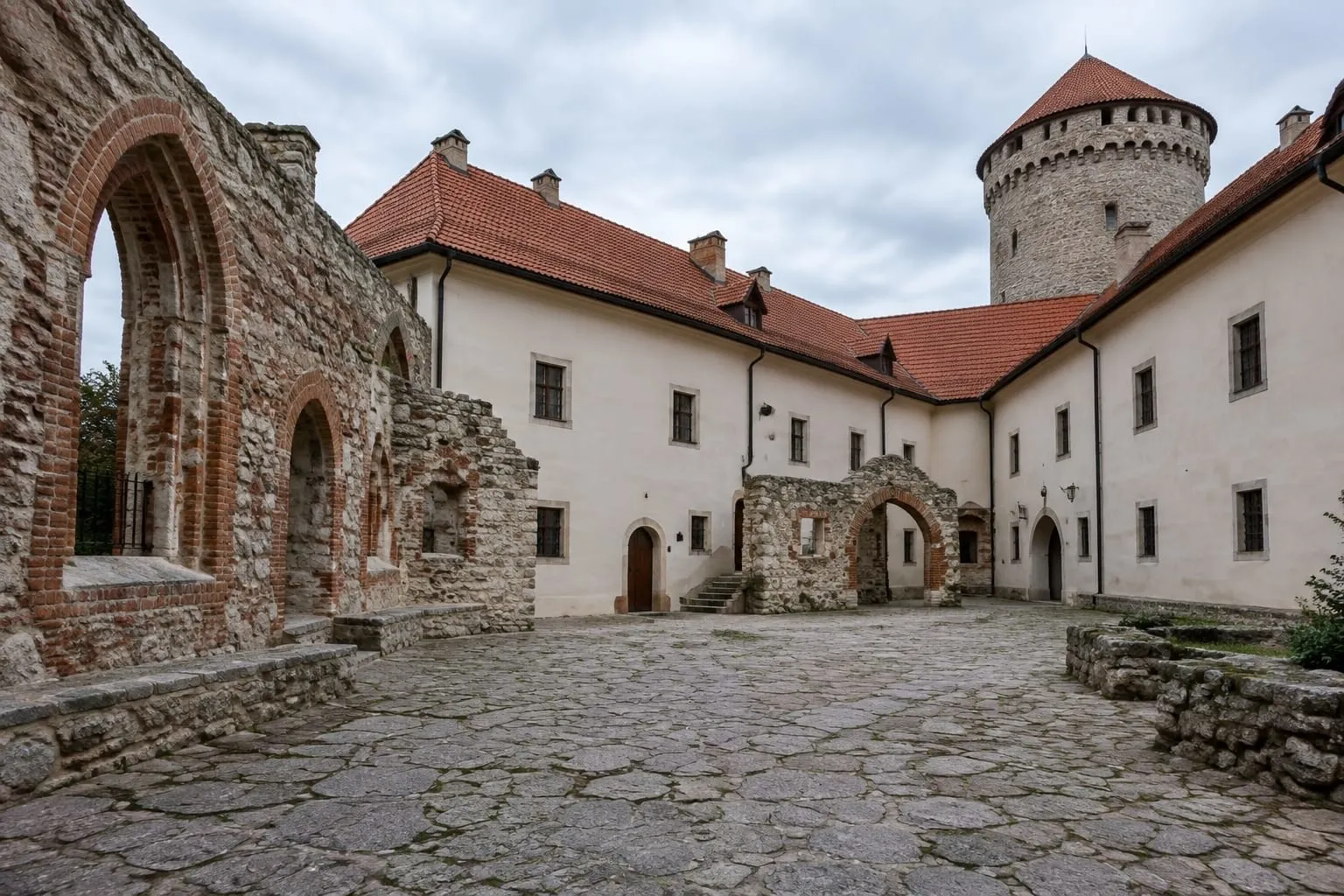
The castle is not a single block. It is a group of buildings from different periods around a shared courtyard. The overview below is based on the museum’s descriptions and helps explain what stood where and what will be on view after the renovation.
| Part of the complex | Date of construction | Former function | What we will see |
|---|---|---|---|
| Middle Castle (House Amid the Saltworks) | end of the 13th century | seat of the salt works management | Gothic Hall, cellars with an archaeological exhibition |
| North Castle (Saltworks House) | 15th century | chapel, library, officials’ apartments | wall paintings in five rooms, eventually the salt cellars |
| South Castle | newer part, being rebuilt | service buildings | educational space and food area |
| Tower | 14th century | part of the town walls, prison | view over the courtyard from the gallery |
| Defensive wall | end of the 13th century | protection of salt and documents | oval sandstone wall |
In the courtyard there is an exploratory shaft from the mid-13th century, the oldest mining shaft in Wieliczka. Its actual depth is unknown, and finds from its fill include pottery, a wooden bowl and two ropes made of lime bast. There are also remains of the 15th-century saltworks kitchen. From the 14th to the 16th century it served free meals to permanent salt works employees, clergy, pensioners, carters and merchants.
Beyond the walls lies a garden laid out in 1564. It was meant to separate the castle from the townhouses and protect it from fire. Between 1714 and 1717 it was arranged “in the Italian manner”, with box, sage, herbs and vegetables for the saltworks kitchen growing in its beds.
It is worth remembering that the castle’s layout does not resemble a knight’s fortress with a tower on every corner. It is rather a group of administrative buildings, remodelled over the centuries to meet the needs of the enterprise. That is why wings from the Austrian period stand next to the Gothic hall, and traces of an ordinary kitchen and storerooms survive beside the medieval wall.
The salt cellar collection and wall paintings
The salt cellar collection is the best-known part of the castle’s holdings. The museum owns almost a thousand objects, and 330 were on display before the renovation. They come from various continents and represent styles from Gothic, through Baroque and Classicism, to Art Nouveau and Art Deco.
The oldest exhibit is a Gothic chalice-shaped agate salt cellar dating from around 1500. The collection also includes silver salt cellars with hunting scenes, made in Augsburg between 1590 and 1594, which in the 19th century belonged to the collection of Baron Meyer de Rothschild. A standout piece is a porcelain condiment set from the Höchst manufactory from around 1760, measuring 60 by 57 cm, described by the museum as one of the largest in the world. There are also glass salt cellars by Tiffany and maiolica from Urbino.
In the Middle Ages a salt cellar was a table ornament and a sign of status. It marked the place of the most important person at a feast. This perspective explains well why the museum of a salt enterprise collects vessels for salt in particular.
The second treasure of the interiors is the wall paintings in the north building. Hidden under plaster for centuries, they decorate five rooms and date from the 16th to the early 20th century. They feature plant motifs, landscapes, illusionistic architecture and part of the coat of arms of the Vasa dynasty, which confirms the royal status of the site. After the renovation, the salt cellar collection is due to move to this very wing, in a new arrangement.
The history of the salt works underground on the Museum Route
With the castle closed, the best way to learn about the history of the Kraków Saltworks in 2026 is the Museum Route in the mine. It is run by the same Kraków Saltworks Museum in Wieliczka. According to the museum, this route is included in the standard mine ticket. After finishing the Tourist Route you need to join the queue marked “WEJŚCIE DO MUZEUM” (museum entrance).
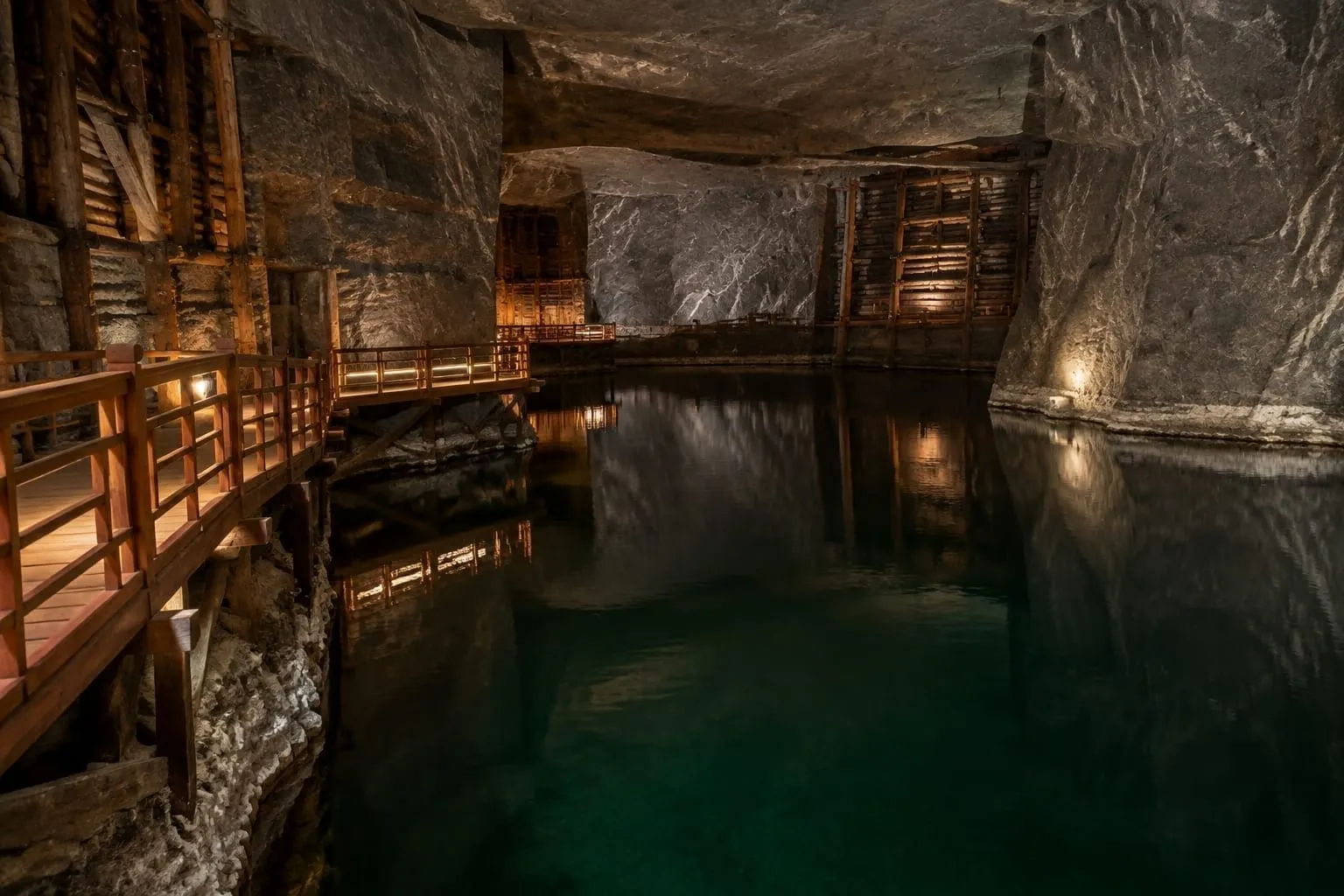
The Museum Route lies entirely on Level III of the mine, is about 1.5 km long and takes about an hour. Along it you can see wooden horse-powered treadmills, known as horse gins. The museum describes the sixteen-metre 17th-century Polish horse gin as the oldest and largest surviving machine of its kind. There is also the Horn of the Brotherhood of Diggers from 1534, funded by the salt works administrator Seweryn Boner, paintings by Jan Matejko and the Maria Teresa chamber, the largest in the whole mine.
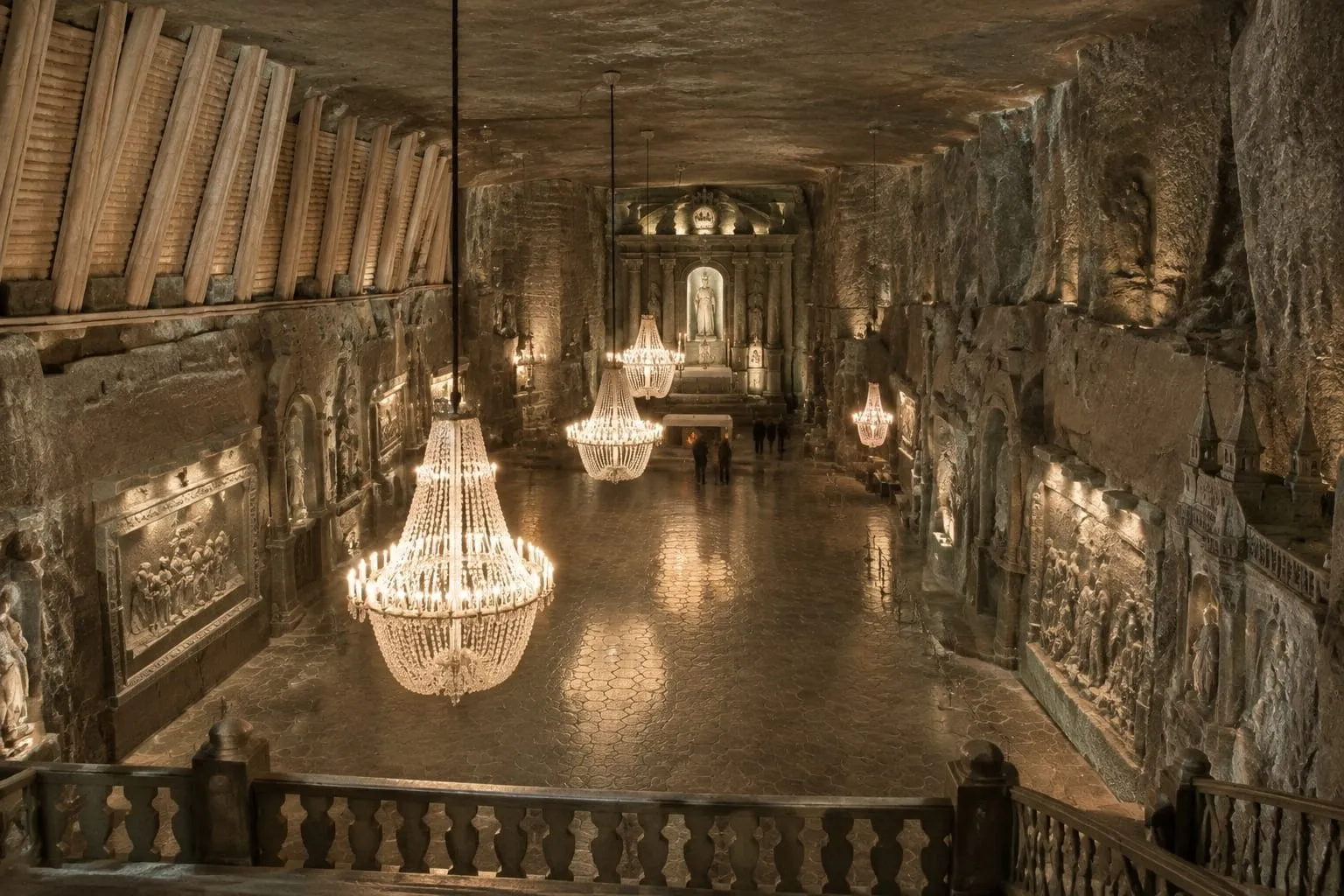
The Tourist Route, which you walk first, is over 2 km long and takes about 1.5 hours. Together with the museum, it is therefore worth allowing about 2.5 hours for the mine tour alone. We write more about the most famous chamber on the Tourist Route in our article on the Chapel of St. Kinga.
The virtual tour of the castle available on the museum’s website completes the picture. It lets you look into interiors that cannot be seen on site in 2026-2028.
How to combine the castle with a mine visit
How, in practice, can you combine the Saltworks Castle with the rest of a visit to Wieliczka during the renovation? We recommend a simple plan in which the castle is a short stop on a walk around town, and the history of the salt works fills the second part of the mine tour.
Getting there and parking
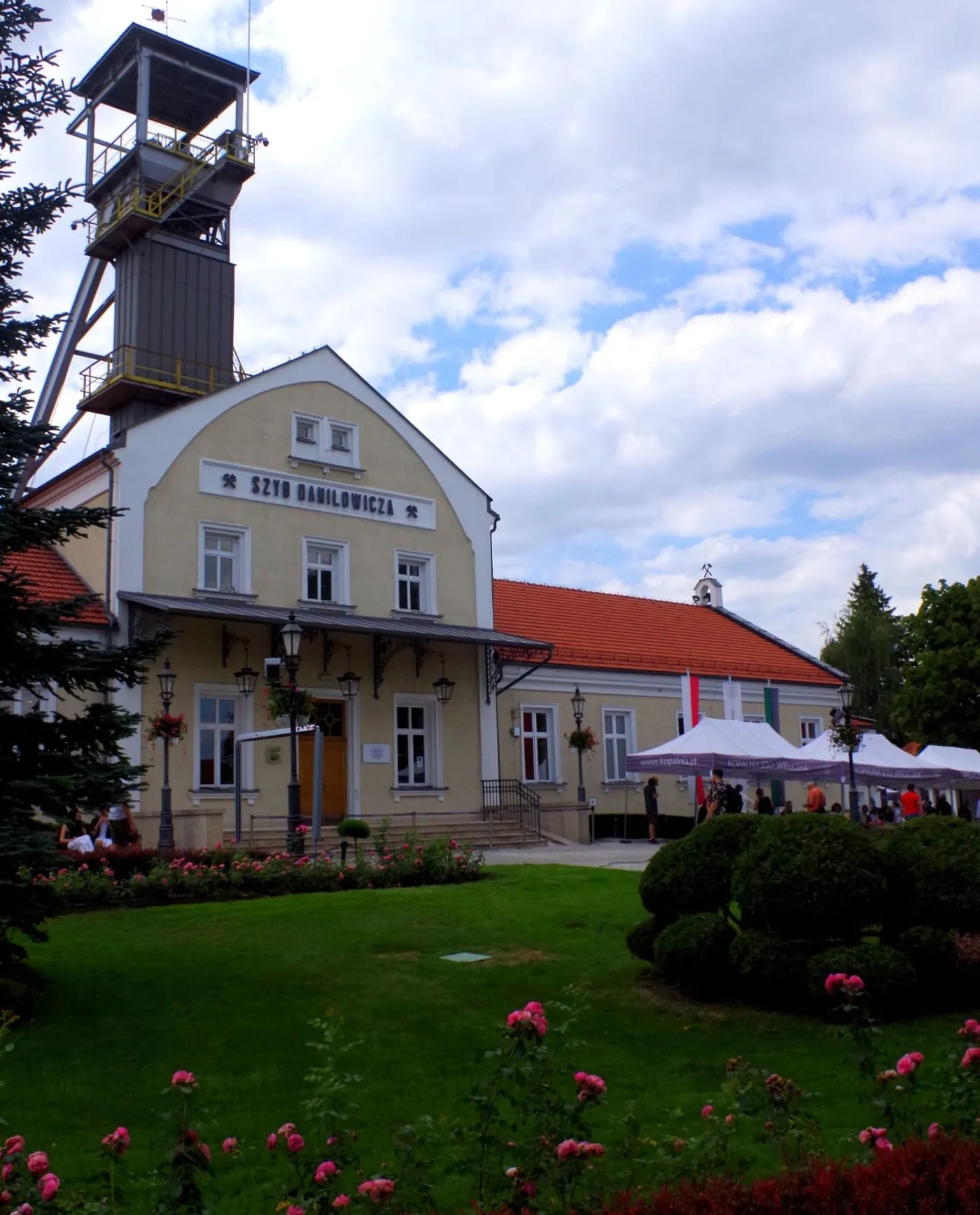
Most visitors arrive by car. A convenient starting point is the Salt Mine car park with online booking at ul. Daniłowicza 13, about 30 m from the Daniłowicz Shaft. Spaces are booked for a specific day, and the ticket with a QR code arrives by email. Entry is possible between 7:00 and 18:00, and exit around the clock. From the car park it is about a 4-minute walk to the Saltworks Castle, about 5 minutes to the graduation tower and about 7 minutes to the Upper Market Square (Rynek Górny).
A sample plan
- In the morning, drive into the car park and enter the mine through the Daniłowicz Shaft.
- The Tourist Route, followed by the Museum Route on Level III, about 2.5 hours in total.
- Lunch at one of the car park’s partner restaurants, Warzelnia Smaków by the Daniłowicz Shaft or Karczma Halit at ul. Daniłowicza 9.
- A walk to the Saltworks Castle on ul. Zamkowa to see the walls from the outside.
- The graduation tower and Rynek Górny to finish the day.
For a full-day plan, a full-day parking ticket is a better choice than a 2-hour one. The car then stays in one place for the whole tour and walk, and it is worth checking the current price list on the website before booking. If you want to be sure of a free space at the weekend, you can book a parking space in Wieliczka in advance.
What to watch out for
The most common mistake is planning the day around old descriptions of the castle with opening hours and ticket prices. In 2026-2028 there is no point setting aside time for the castle interiors or buying tickets for it from resellers. It is better to use that time for an unhurried walk along the Museum Route, which tired visitors sometimes skip after the long Tourist Route.
We describe a more extensive two-day plan, with more places to see in town, in our article Weekend in Wieliczka.
The castle after the renovation
Once the modernisation is complete, the Saltworks Castle is set to change more than at any time since its post-war reconstruction. The museum reports that the exhibition space will grow to about 1,470 m². Previously, the collections and temporary exhibitions were housed only in the central part of the castle, covering about 400 m².
The main new feature will be the permanent exhibition “Salt Jewel in the Crown” (Solny klejnot w koronie). It is to tell the story of the Wieliczka salt enterprise from the 13th century to 1996, when industrial salt extraction ended. The museum is promising interactive and multimedia displays and a new arrangement of the salt cellar collection in the North Castle.
The South Castle is to become an educational and workshop space, and a food area will be created on its lowest level. A public square recalling the old saltworks garden will be created next to the castle. Lifts and an underground link between the buildings will make the complex fully accessible to people with disabilities.
For visitors, this means that from 2029 a visit to Wieliczka may naturally consist of two museum parts, one underground in the mine and one above ground in the castle. Visitors may also get to see the 14th-century walls uncovered during the renovation. The complex is also to gain modern ventilation and air-conditioning systems and better protection for the collections, which will make it possible to display more valuable objects than before. Construction schedules can slip, so before travelling around the turn of 2028 and 2029 it is worth checking the museum’s announcements.
The Saltworks Castle in brief
The Wieliczka Saltworks Castle is the former seat of the Kraków Saltworks, an enterprise that in the 14th century provided as much as a third of royal revenue. From the end of the 13th century until 1945, this is where the mines were managed, wages were paid, workers were fed and salt was sold. Since 2013 the castle has been part of the UNESCO listing together with the mines in Wieliczka and Bochnia.
In 2026 the castle and courtyard are closed for renovation, which according to the museum will last until the end of 2028. During this time the interiors, the Gothic Hall, the wall paintings and the salt cellar collection can only be seen on a virtual tour. From the outside you can see the walls and the shape of the castle on ul. Zamkowa.
The point made at the start holds up. The renovation does not close off the history of the salt works, because its most important chapters are shown on the Museum Route on Level III of the mine, included in the standard ticket. The horse gins, the Horn of the Brotherhood of Diggers and the Maria Teresa chamber give a fuller picture of the salt works than a visit to the castle alone.
The most convenient plan is to walk, after the mine, to the castle, the graduation tower and Rynek Górny. All these places are a few minutes from the car park 30 m from the Daniłowicz Shaft, so the car can stay in one place all day. Once the castle reopens in its new form, Wieliczka will gain another reason to return, this time with time set aside for the above-ground part of the story of salt.
Questions about the Saltworks Castle
Is the Saltworks Castle in Wieliczka open in 2026?
No. The Kraków Saltworks Museum in Wieliczka states that the castle and its courtyard are closed for renovation, which will last until the end of 2028. The reopening in a new form is planned for the turn of 2028 and 2029.
Where does the name Saltworks Castle come from?
In Polish it is called Zamek Żupny, from the word “żupa”, which once meant a salt mine. The castle was the seat of the Kraków Saltworks (Żupy Krakowskie), an enterprise that included the mines in Wieliczka and Bochnia as well as the brine boiling houses. It was not a knight’s residence but a centre for managing salt, with a treasury, archive, court and kitchen for the workers.
Where exactly is the Saltworks Castle?
The museum’s address is ul. Zamkowa 8 in Wieliczka. According to the museum, it takes about 4 minutes to walk from the castle courtyard to the Daniłowicz Shaft and about 3 minutes to the Regis Shaft.
Does the mine ticket include entry to the museum?
Yes, the Kraków Saltworks Museum Route on Level III of the mine is included in the standard ticket. After the Tourist Route you need to join the queue marked “WEJŚCIE DO MUZEUM” (museum entrance). The mine ticket does not cover the Saltworks Castle, which is currently closed anyway.
What was the saltworks kitchen?
It was a kitchen within the castle grounds where, from the 14th to the 16th century, free meals were served to salt works employees, clergy, pensioners, carters and merchants. The museum calls it the first staff canteen in Poland. Parts of it survive in the courtyard.
Where can I see the salt cellar collection during the renovation?
The collection is not currently on display in the castle. The museum offers a virtual tour of the castle on its website. After the renovation, the salt cellars are due to move to the North Castle in a new arrangement.
How much time should I allow for Wieliczka with the mine and a walk to the castle?
The Tourist Route takes about 1.5 hours and the Museum Route about an hour. With lunch and a walk to the castle, the graduation tower and Rynek Górny, it is worth allowing 5-6 hours, so when arriving by car a full-day parking ticket works better.